Zenwice
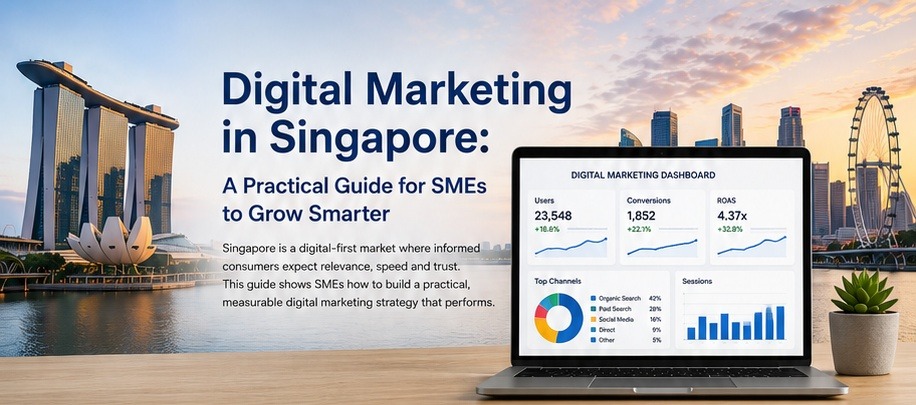
Build a practical digital marketing strategy for your Singapore SME with seven steps covering goals, audiences, channels, content, testing and measurement.
Digital marketing in Singapore involves more than running advertisements, publishing social media posts or adding keywords to a website. These activities produce better results when they operate as parts of one connected system.
For an SME, that system should connect a commercial objective with a defined audience, a clear message, suitable channels and reliable measurement. Without those connections, a business may generate traffic and engagement without knowing whether its marketing is contributing to enquiries, sales or customer retention.
This seven-step roadmap explains how Singapore SMEs can build a focused digital marketing strategy without spreading their resources across too many platforms.
It is possible to be highly active online without creating meaningful business value. A company may publish every week, receive website visitors and generate advertising clicks while attracting few suitable customers.
The problem is often not a lack of activity. It is a lack of alignment.
A practical digital marketing system connects:
Singapore’s Industry Digital Plans similarly present digitalisation as a staged process, helping SMEs identify suitable digital solutions and skills at different points in their development.
Begin with the business result, not the marketing platform.
“Post more often on LinkedIn” is an activity. “Generate qualified consultation enquiries from operations managers” is an objective.
Choose one primary result for the next campaign period. Depending on the business, this could be:
Next, decide how the result will be evaluated. A lead-generation campaign might track booked consultations, suitable enquiries, lead-to-opportunity rate and cost per qualified lead.
Website sessions, video views and impressions can provide useful context, but they should not become substitutes for business outcomes.
“SME owners in Singapore” is usually too broad to guide an effective campaign.
Define the situation that causes a potential customer to search for help. A business owner may be replacing an outdated website, entering a new market, reducing reliance on referrals or trying to understand why advertising is generating poor-quality leads.
Document the customer’s:
This information gives the marketing team a stronger basis for selecting keywords, writing advertisements, planning content and designing landing pages.
A clear buying situation also makes the message more relevant. Instead of promoting a generic service, the business can address the specific problem that caused the customer to begin researching.
Increasing traffic does not solve problems with an unclear website or a weak conversion path. Before increasing campaign investment, review the digital foundation that visitors encounter.
A visitor should quickly understand:
Avoid broad statements that could describe almost any competitor. Specific positioning helps suitable prospects recognise that the service is relevant to them.
Each important page should have a logical next action. That may be requesting a quotation, booking a consultation, downloading a useful resource or completing a purchase.
The action should match the visitor’s level of intent. Someone reading an introductory article may not be ready to request a proposal, but they may be willing to read a detailed guide or explore a relevant service.
Analytics, advertising tags, conversion events and customer relationship management processes should be planned before a campaign launches.
Without reliable tracking, the team may not know whether a poor result comes from the audience, message, channel, landing page or sales follow-up.
Zenwice approaches digital transformation through engineering discipline, applied AI and accountable implementation. Its stated capabilities include websites, product development, brand systems, social and digital marketing, AI chatbots and AI-generated content.
A digital marketing strategy for SMEs in Singapore does not need to include every available channel. It needs a small number of channels with clearly assigned roles.
| Channel | Primary role |
|---|---|
| Search engine optimisation | Build long-term visibility for relevant searches |
| Paid search | Capture existing demand |
| Paid social media | Reach selected audiences and test messages |
| Organic social media | Educate prospects and maintain familiarity |
| Content marketing | Answer questions and demonstrate expertise |
| Email and CRM | Nurture prospects and support retention |
A B2B consultancy might combine search marketing with educational articles and LinkedIn content. A consumer business may place greater emphasis on social discovery, paid campaigns and email retention.
The appropriate mix depends on how customers research, compare and purchase—not on which platform is receiving the most attention.
Businesses can explore Zenwice’s broader technology and digital transformation services when considering how marketing, websites, content and technology should work together.
Content should help a potential customer make progress towards a decision. It should not exist simply to fill a publishing calendar.
Awareness content helps customers recognise and define a problem.
Suitable formats include:
Consideration content helps customers understand their options.
This may include:
Decision content reduces uncertainty when a customer is evaluating providers or approaches.
Useful subjects include the expected process, project responsibilities, implementation requirements, timelines, limitations and next steps.
One detailed article can also be adapted into an email, a short video, several social posts and material for sales conversations. Repurposing works best when each format retains the main insight but is adjusted for its channel and audience.
Digital marketing should produce learning as well as immediate results.
Avoid changing the audience, advertisement, offer and landing page simultaneously. When too many variables change, the team cannot identify what caused the result.
A useful experiment includes:
For example, a company could test whether operations managers respond more strongly to a cost-reduction message or a service-reliability message. The audience and landing page would remain consistent while the message changes.
This approach makes it easier to distinguish between a targeting problem, a messaging problem and a conversion problem.
Marketing reports often stop at impressions, clicks and form submissions. Business leaders need to understand what happens after the initial conversion.
A useful measurement path is:
Reach → Engagement → Conversion → Qualification → Opportunity → Revenue or retention
For every stage, identify:
A form submission may count as a conversion, but the sales team should also record whether it came from a suitable customer. Otherwise, a campaign may optimise for a large number of low-quality enquiries.
Weekly reviews can focus on campaign delivery and tracking. Monthly reviews can assess lead quality and channel contribution. Quarterly reviews can evaluate commercial outcomes and strategic priorities.
Businesses should consider privacy, consent and communication governance when building marketing processes.
Singapore’s Do Not Call provisions apply to specified marketing messages sent to Singapore telephone numbers. Organisations using telephone calls, SMS or fax marketing should understand the applicable requirements and establish an appropriate checking and record-keeping process.
Account ownership is another important consideration. Businesses should retain suitable access to their:
Clear ownership reduces disruption when employees, agencies or suppliers change.
Local relevance also matters. Singapore may be geographically compact, but customer expectations differ by industry, buying situation, language preference and decision complexity. Localising a campaign requires more than inserting “Singapore” into the copy.
Common problems include:
A larger budget does not automatically correct these issues. Better sequencing, clearer ownership and stronger measurement often provide a more useful starting point.
During the first 30 days, define the objective, audience, positioning, channel roles and measurement plan. Review the website and remove obvious barriers from the conversion path.
During days 31 to 60, launch a focused campaign and publish content that answers important customer questions. Keep the number of channels manageable.
During days 61 to 90, compare lead quality, conversion performance and commercial contribution. Decide whether each activity should be scaled, refined, paused or redesigned.
The purpose of the first 90 days is not to declare the strategy complete. It is to establish a disciplined cycle of execution, measurement and improvement.
Effective digital marketing in Singapore is not about appearing on every platform. It is about connecting business goals, audience insight, content, technology, channels and measurement.
Zenwice is a Singapore technology company that consults, engineers and implements, using the positioning “Built by engineers. Powered by AI.” Its approach places engineering discipline and accountability at the centre of digital work.
Learn more about Zenwice and its capabilities, or contact Zenwice to discuss your digital marketing priorities, current constraints and the most practical next step.